
Nature Neighbourhoods: Building the Case and Capacity for Community-led Change
Case study by Rory Crawford, The National Trust
Photos Credit: Rory Crawford
Who and What?
Nature Neighbourhoods was a partnership between three national nature NGOs – the National Trust, RSPB and WWF-UK, and eighteen community organisations working on urban nature in one form or another, supported by the National Lottery Community Fund and Co-op. The project evaluation can be read here; this might be considered an abridged and more discursive version of this more comprehensive work.
The NGOs took on the admin of managing the project and reporting to funders, and hosted a communications lead and Project Officers, whose role it was to provide more tailored support to each of the community organisations. All these organisations received flexible grants of ~£28,000 to participate in the project, and all used some (if not all) of the funds to cover staff time. Their reporting requirements were kept to a minimum.
In the broadest terms, the project sought to:
- Support Neighbourhood Action for Nature by involving the community in co-designing a neighbourhood plan for nature and climate action – essentially a blueprint for popular ideas for neighbourhood improvements.
- Build Community Capacity both within the participating community organisations and in the wider community, by providing self-selected training and convening a peer-to-peer support network.
- Drive Local Systems Change by working with both community organisations and local institutions/organisations (esp. Local Authorities) to address some of the systemic barriers to successful community action.
- Support Organisational Learning in recognition that nature NGOs don’t have a strong reputation for community-led urban work, build the capability of the project partners to support community action for climate and nature, improving collaboration at scale.
The Environmental Justice Issues
With a strong environmental justice lens, the focus of the project was on urban neighbourhoods that are under-served with respect to access to nature. Community organisations were at the centre of decision-making and change enactment, recognising different sizes of organisation and organisational readiness, the disadvantages or historic underinvestment faced by communities, and supporting efforts to tackle barriers.
Where?
The map shown here highlights the organisations, cities and towns the project worked with.
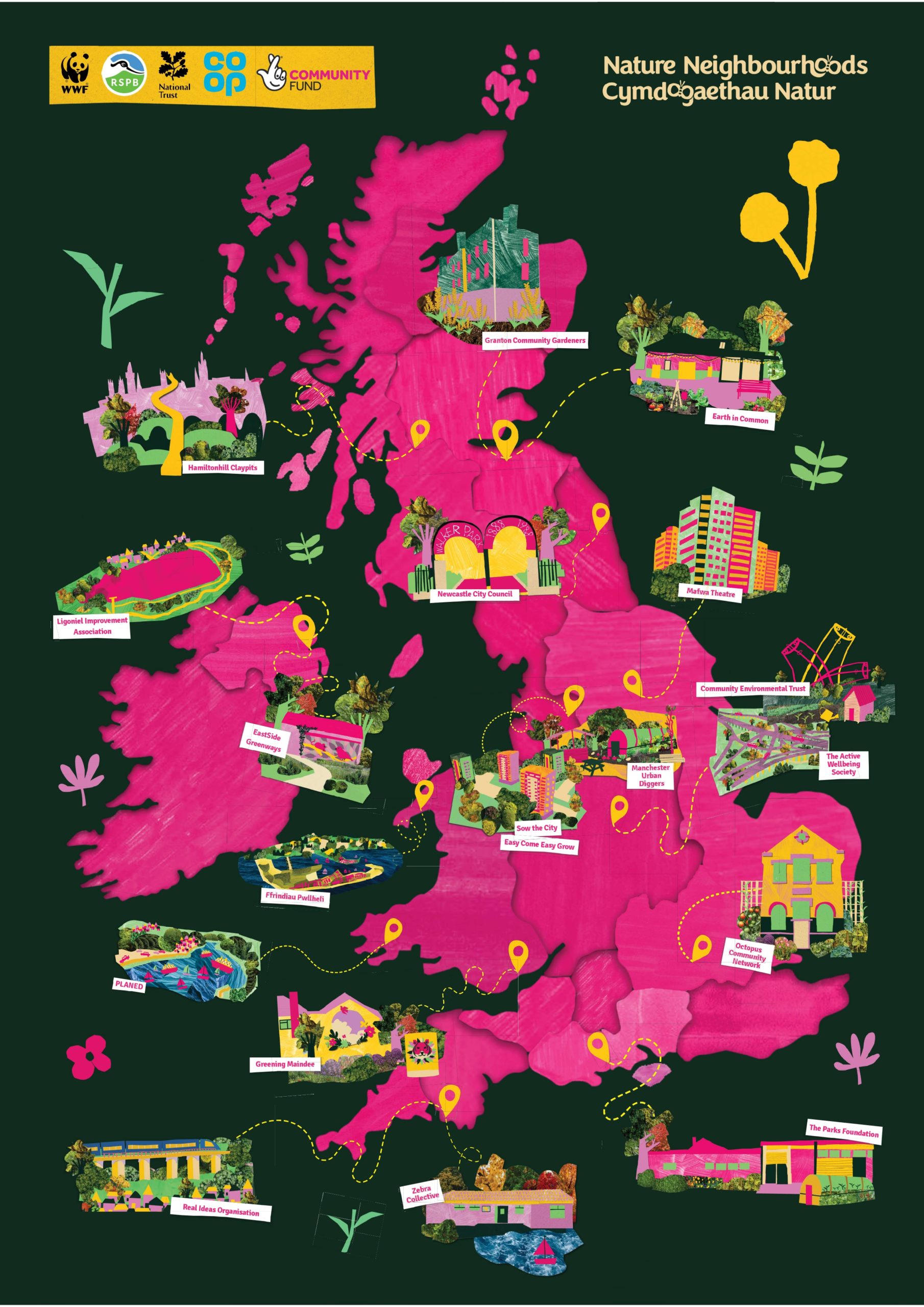
Artwork by Mafwa Theatre
How and Why?
How we worked together was given strong emphasis throughout the work – this case study is littered with mentions of ‘co-design’. In the nature sector, given our scientific approach and standards, we naturally gravitate towards outcomes – how many trees, breeding birds, pollinators per square inch etc. There are often good reasons for this, but in densely-populated places in particular, this can be to the detriment of long-term stewardship. Scientific knowledge of what a ‘good nature action’ looks like in a given place is of course useful, but it needs to work with what people living there want and need. A focus on an outcome and not the process can result in ‘telling’ rather than ‘listening’. By deciding action together throughout this project, we designed more meaningful training programmes, focussed on community-led efforts, and communities have created plans for nature that will serve both biodiversity and people.
 This work put the nature NGOs in an ‘enabling’ rather than ‘delivery’ role, differentiating it from how we tend to conduct our work more generally, where we make decisions and might invite others to join us. In this case, the decision-making sat at the community level, with us working in support of the priorities identified by those most affected. This was the golden thread that ran through the project – the community organisations decided what training they wanted, the neighbourhood plans were co-designed with community members, and the knowledge, expertise and connections of NGO colleagues were used to support local systems change to facilitate the creation of more nature in the participating neighbourhoods.
Why place so much emphasis on this being community-led? Well, because it forms the foundation of nature and climate actions being sustained by those most likely to be involved in looking after any interventions into the future, long after the creation of a garden, urban forest or wildflower meadow is paid for and completed.
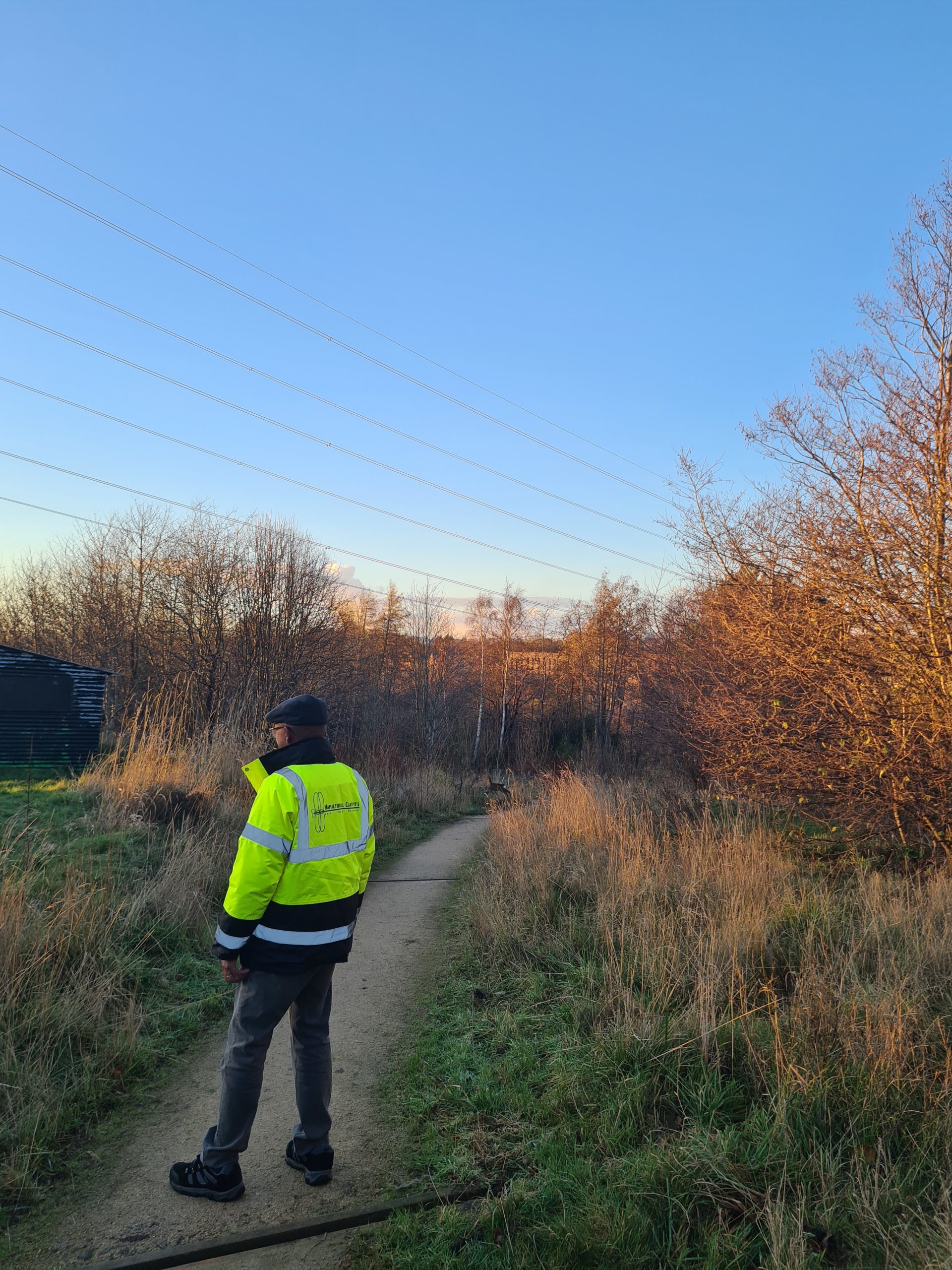
Photo: Bob Alston of Hamiltonhill Claypits Local Nature Reserve Management Group leading a walk through the site in Glasgow
 We did not have any biodiversity outcome KPIs – this project was about time and space, building the capabilities, capacity and connections in the communities involved. The community sector is delivering a huge amount of the positive change happening in neighbourhoods, but is struggling under the strain of grant funding that is reducing in size and is frequently associated with onerous reporting requirements.
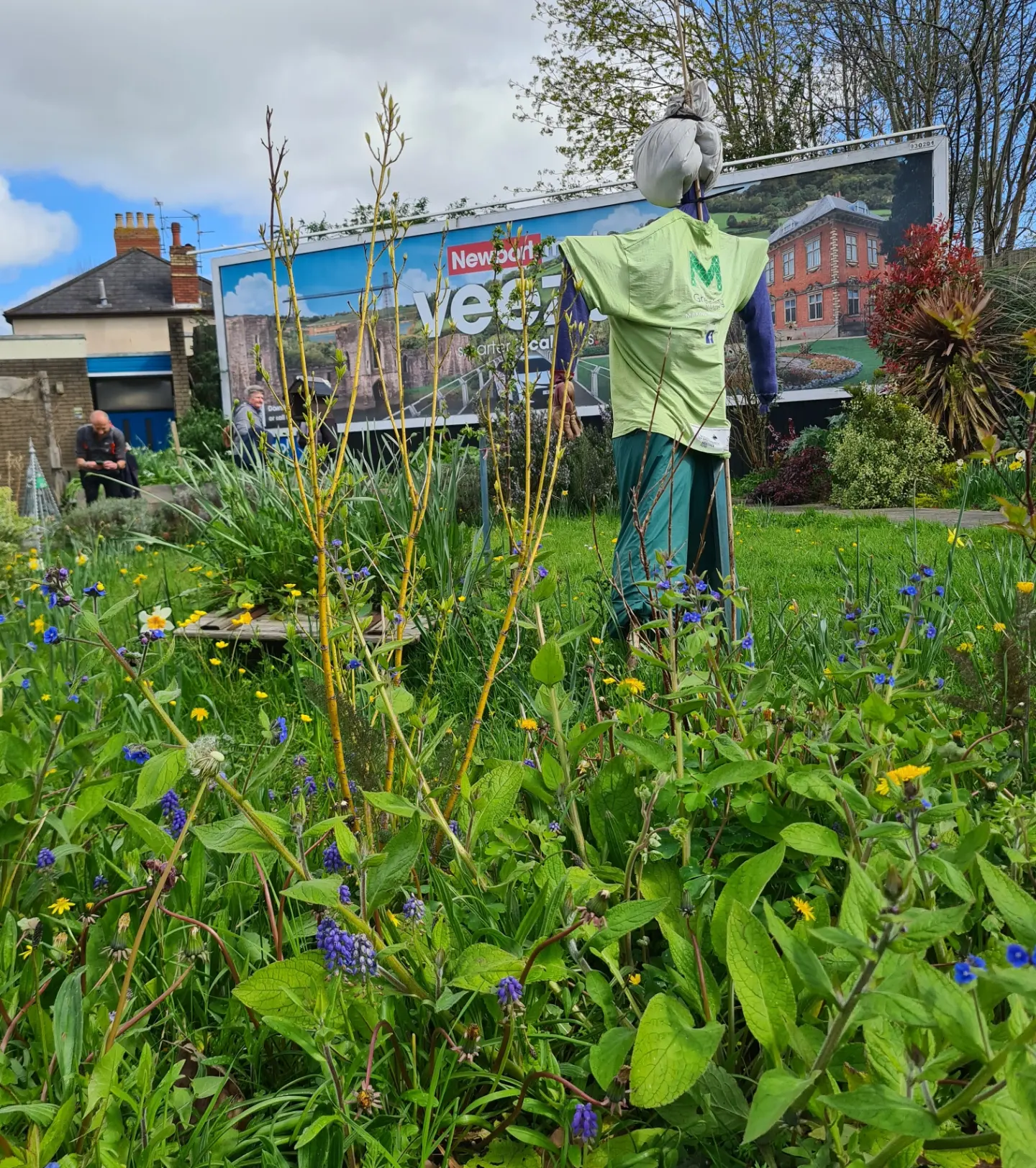
Even without such KPIs, we saw nature-positive change happen in the neighbourhoods over the course of the project – in Maindee, Newport, Greening Maindee collaborated with the community and a garden designer to turn a derelict street corner into a beautiful new green space for everyone to use. Easy Come Easy Grow – a resident-led community organisation in Newton Heath, Manchester (brought to life in the course of project!) – secured the planting of 100 trees by Manchester City Council to address tree equity issues in the neighbourhood. Easy Come Easy Grow, The Parks Foundation in Kinson (Bournemouth), Mafwa Theatre in Lincoln Green (Leeds) and Zebra Collective in Devenport (Plymouth) all created new community growing spaces.
Photo: One of the spaces converted by Greening Maindee
What have we learned?
 Communities have great ideas for what nature and climate action should look like in their places. This tells us we should ‘trust the process’ – not knowing exactly what outcomes will look like can be uncomfortable for funders, science-based NGOs, Local Authorities etc., but we could re-frame our expertise as ‘on tap’ not ‘on top’.
The big themes in the neighbourhood plans included:
- improving access to nature – with facilities (‘a brew and a loo’), activities that make all parts of the community feel welcome and physically accessible spaces.
- creating new wildlife habitats – converting the grey to green (esp. green corridors to connect existing green spaces)
- enhancing existing green spaces (e.g. wildflower planting, pond creation, hedging, tree planting to address tree equity)
- food growing – especially as a vehicle for community connection and skills building
- places to play – create new spaces and improve existing
- training and skills – to build community capacity to deliver the actions listed here, but also for green jobs
- community ownership – both a ‘sense of’, and literal ownership of, land and assets
- new partnerships (with Local Authorities, NHS, youth workers, businesses) to support multiple agendas – health, wellbeing, employment and more.
You can check out examples of the variety of Neighbourhood Plans: Greening Maindee, Octopus Community Network, Zebra Collective, Manchester Urban Diggers (Platt Fields).
Find here short films showcasing some of the community organisations we worked with on Nature Neighbourhoods.
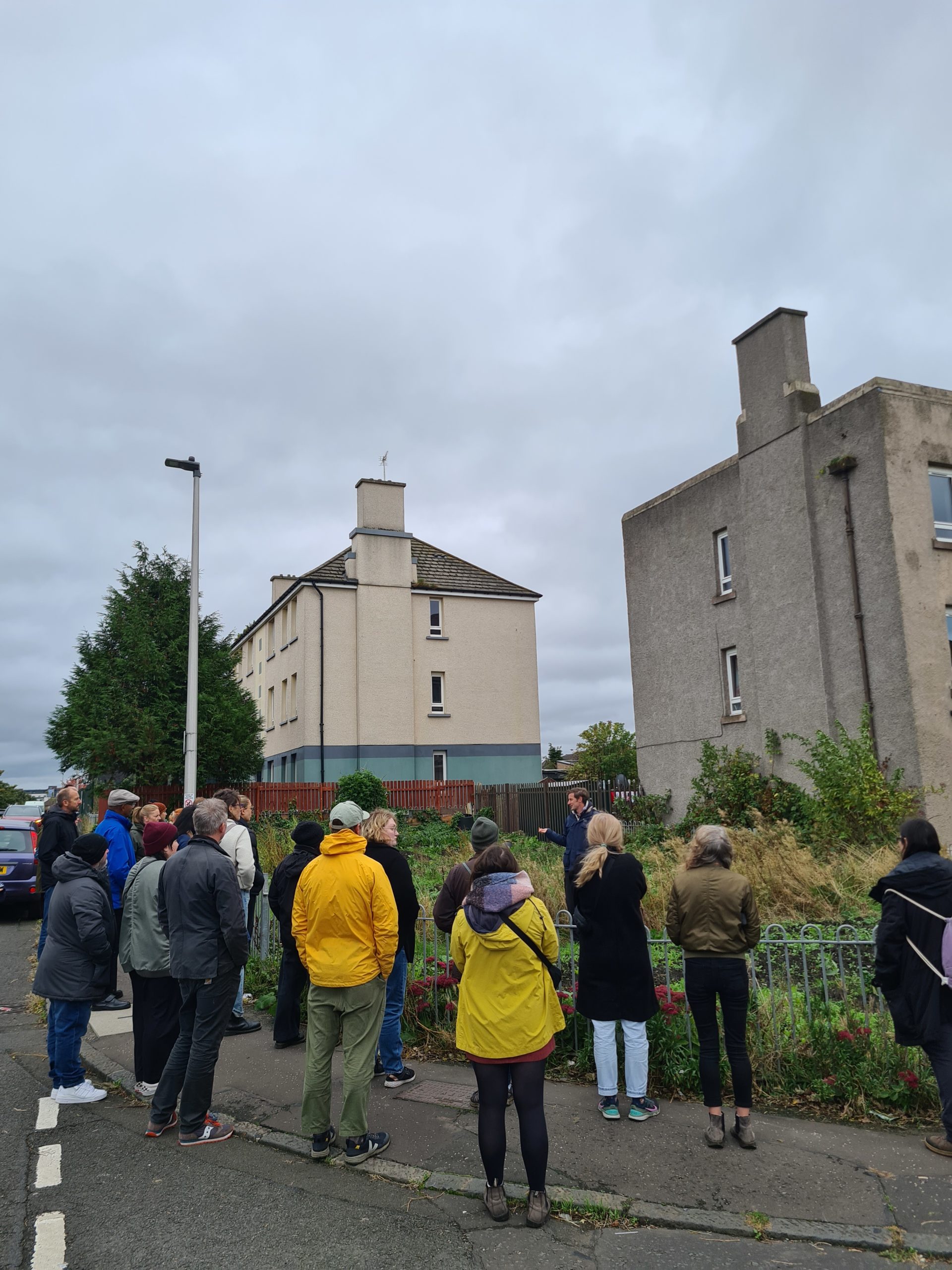
Photo: A visit from community organisations participating in Nature Neighbourhoods to Granton, Edinburgh
Flexibility was key – from the funders (in terms of openness on outcomes), and then in turn for the community orgs, who received funding without heavy administrative load or lots of deliverables. All the community organisations emphasised the value of this as a ‘time and space’ project that helped them get off the hamster wheel of applications, delivery and reporting.
Implementation funding would be great – as mentioned, our project was not focussed on delivering physical changes, but they are clearly important for building support, energy and more action. While we did see action on the ground (as noted above), and many of the organisations involved are using their neighbourhood plan as a source document to secure funding for projects, even a relatively small amount of seed funding to kick-start work would go a long way in future similar initiatives.
Focus on and invest in relationships: between NGOs and community organisations, community organisations and their communities, with the Local Authority, with partners. The success or failure of a given intervention rests on our ability to collaborate effectively. This requires us to ‘move at the speed of trust’ – not just to heal any open wounds from past difficult interactions, but to recognise our respective strengths and address power dynamics.
There is a need to differentiate the offer for community organisations in the future – taking into account the differing needs of newer or smaller hyperlocal organisations, compared to larger city-wide anchor organisations, and recognising where there are gaps in the community sector ecosystem in a given place.
 Nature NGOs have an important role to play in urban greening, but perhaps in a surprising way. Community organisations wanted support in fundraising, how to work with a Local Authority, youth work, volunteering, inclusion and communications, as well as some more ‘hands-on’ support from a Project Officer, rather than on the practicalities of physically creating urban green spaces. Focussing efforts on these capacity-building interventions is more likely to result in more nature and nature connections in urban places. Given that most of us (~80% of the UK population) live in towns and cities, these are important considerations, as these presently rather nature-poor places are where nature connections are first made, sustained in our day-to-day lives and ultimately transferred into pro-nature behaviours. There hasn’t been a wholesale move from the nature NGOs into this ‘enabling’ mindset, but the groundwork has been laid to facilitate some positive next steps…
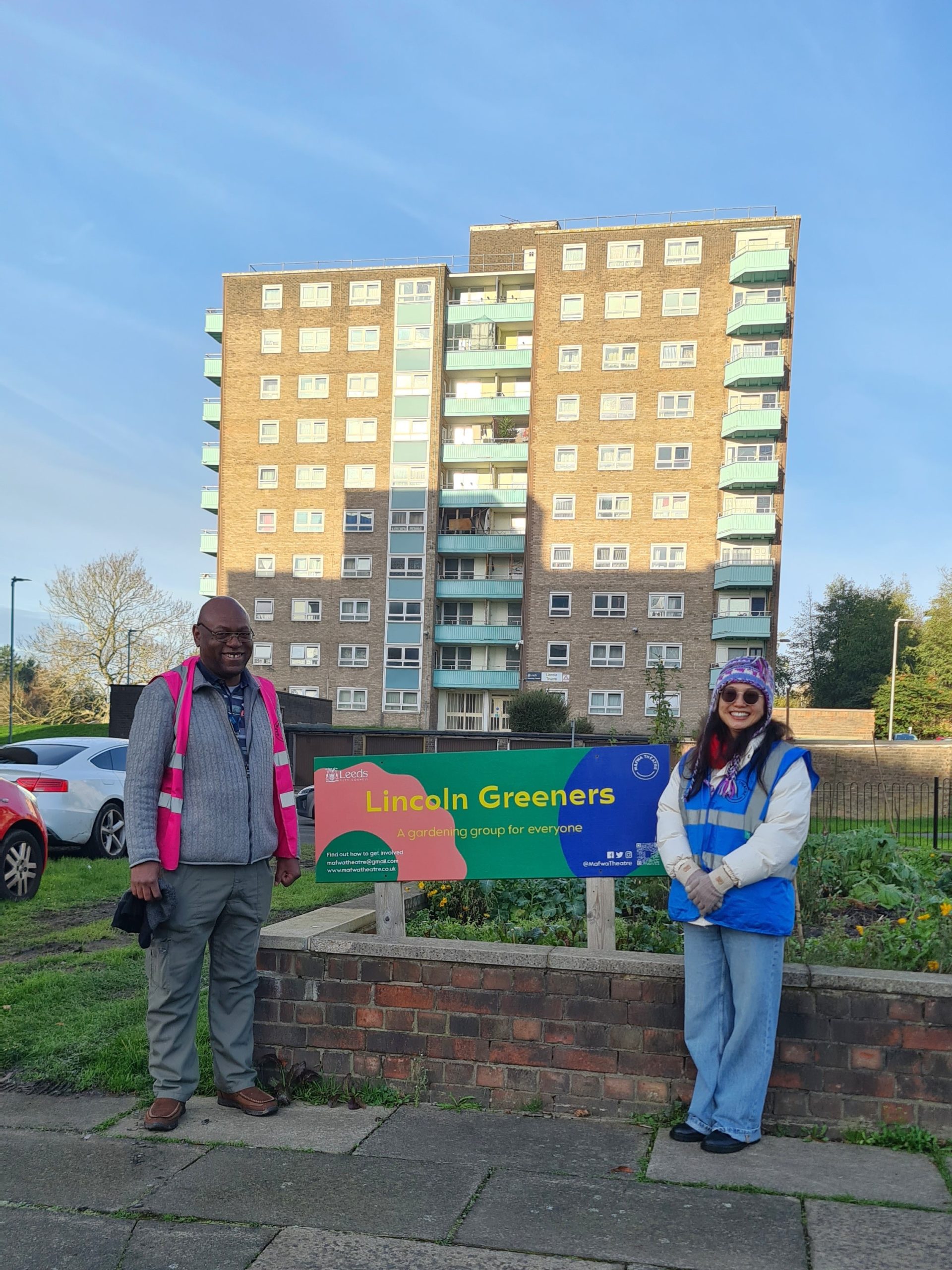
Photo: Bei and Danmore of Mafwa Theatre in Leeds, standing by the growing beds tended to by their ‘Lincoln Greeners’ group
What Now?
Nature Towns and Cities – a new national urban nature programme – is incorporating the learnings and insights built through Nature Neighbourhoods (and other initiatives, like the Wildlife Trusts’ Nextdoor Nature project) into a developing Communities programme, which will be co-designed with the community sector over the course of 2026. Ultimately, it will look to develop (and then test) solutions to the central systemic issues experienced by community organisations, namely access to sustainable funds and permission to do their work (linked to power dynamics).
Case Study Team
Rory Crawford is the communities programme manager for Nature Towns and Cities, and managed the Nature Neighbourhoods project at the National Trust.
GET CONNECTED WITH RORY
WATCH HERE: A SHORT FILM PRESENTED BY RORY FOR THE NATURE NEIGHBOURHOODS PROJECT
community-accessible resources from the project
Community Guide to Co-Design: Why does it matter, and what is the co-design process? Read More Here
Guidance for Working with diverse communities: Growing roots for equity and inclusion. Read More Here
Support young people through nature: new experiences in the outdoors with the G20 Youth Project. Read more Here