
Hearing loss and the extinction of experience
An environmental justice case study by Dr Siddharth Unnithan Kumar, University of Exeter
As David Abram writes in The Spell of the Sensuous, humans are tuned for relationship: through eyes, ears, tongues, and the like, our senses bind us into life-giving reciprocity with the rhythms and textures of this animate earth. The soughing wind and pulsing ocean tides, leaves rustling and rain falling, the joy of the dawn chorus and tranquility of its dusk counterpart – these are some of the sounds that many people consider vital for their connection to, and experience of, the more-than-human world.
The Project
Motivated by the importance of sound and auditory perception for being in relation with other beings, through two collaborative papers in the journal People and Nature (one published, the other forthcoming) we sought to explore how hearing loss can change the way people experience biodiversity, focusing on the possible effects of ageing on a person’s ability to hear birdsong. The main concept we employed was that of a ‘personalised ecology’ – the set of embodied, sensory interactions a person has with other species that is unique to their circumstances, and changes through days, weeks, seasons, and years.
Our study began by choosing ten bird species in Britain (or, depending on how agency is considered, one might say that they chose us): Robin, Goldcrest, Wren, Blue tit, Wood pigeon, Blackbird, Chaffinch, Nightingale, Cuckoo, and Sparrowhawk. We used audio recordings of these birds’ songs from the citizen science repository xeno-canto to derive frequency-amplitude spectra (these are graphs that provide a measure of how loud different components of a bird’s song are) for each of the ten species. Then, following a method employed by ornithologists Michael Emlen and Robert DeJong, we superposed public health data of age-related hearing loss onto these song spectra. From these overlayed images, we estimated how the perceived loudness of birdsong may change for people of different ages. Finally, we incorporated biogeographical data on bird and human populations to investigate the implications of hearing loss for the distribution and abundance of human-bird interactions in Britain.
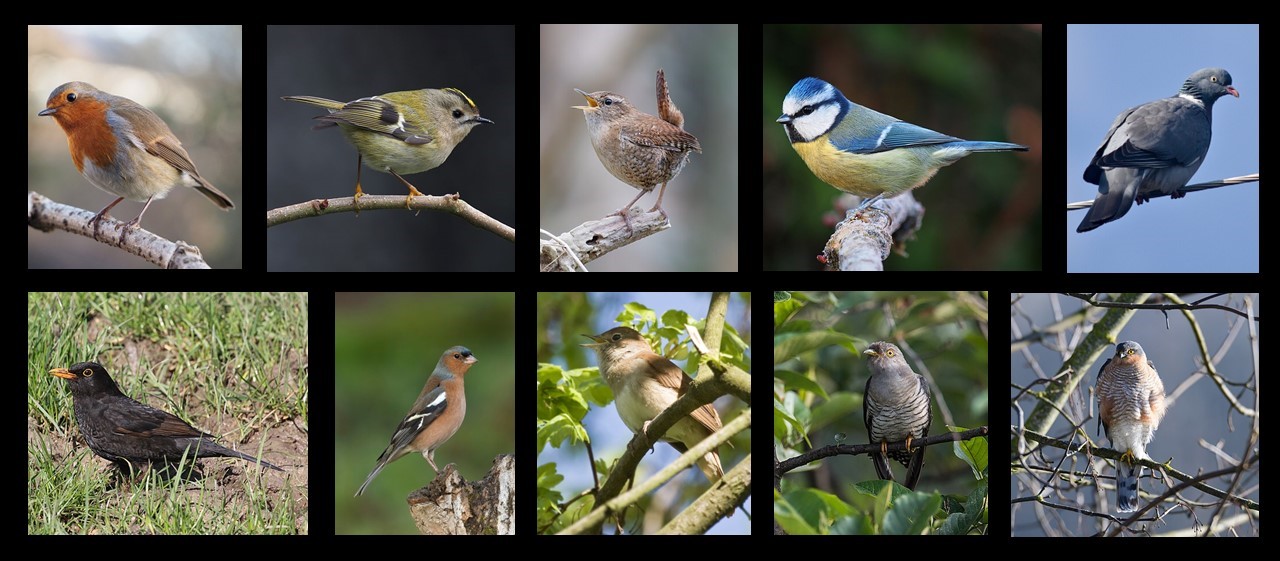
From top-left to bottom-right: Robin, Goldcrest, Wren, Blue tit, Wood pigeon, Blackbird, Chaffinch, Nightingale, Cuckoo, and Sparrowhawk. Images from Wikimedia Commons, with Creative Commons licences that permit their reproducing and cropping, as has been done here.
Image credits: Francis C. Franklin, Francis C. Franklin, Alexis Lours, Francis C. Franklin, Alexey V. Kurochkin, Charles J. Sharp, caroline legg, J. Dietrich, Creepanta, Isiwal.’
The Justice Issue
Now, one of modernity’s vanishing tricks is to separate what you know from who you are – from how you live, act, and relate in the world. The euro-colonial natural sciences have long tried to study the world as an object of interest, held at a distance for evaluation by a disembodied human subject external to the world it scrutinizes – rather than studying the world as a means to enter into deeper, loving, and ethical relation with it. The lens of personalised ecologies, however, shifts focus away from looking at ‘nature’ as something separate from humans, and instead to relationships between humans and other species – and with this change in focus comes a change in priorities, towards questions of environmental justice.
First, our results highlight how the extinction of nature experiences disproportionately affect people with significant hearing loss. For example, birds who sing at higher frequencies (such as Goldcrest and Blue tit) may become inaudible for older listeners even at distances of 5-10 metres. Moreover, because higher frequencies are generally lost with age to a greater degree than lower ones, birdsong can become not only quieter but also unrecognisable or indistinct from anthropogenic, mechanical sounds. This means that the description of bird calls provided in ecology textbooks, field guides, and signboards may be meaningful only to those people with good hearing – hence these descriptions provide information on a particular (not universal) perception of birdsong, that may include some people’s experiences and exclude others.
There is, however, a hopeful side to this: by better accounting for how nature connection can differ markedly as a consequence of variation in sensory capabilities, more equitable mitigating strategies can be designed and implemented to address this. Examples we explore in the aforementioned two People and Nature articles include making hearing aids more affordable and widely accessible; creating bird habitat close to where people live; and raising awareness about (and destigmatising) hearing loss, which is a prevalent and global phenomenon. Such efforts could also help address systemic inequities in human-nature relationships, such as the often greater availability of biodiverse areas in higher-income urban neighbourhoods, the difficulty of affording high-quality hearing aids, and the uneven socioeconomic distribution of hearing loss (and impacts of stress on sensory perception) that most affect disadvantaged and marginalised communities.
Pathway Forward
In light of our study, we advocate for greater attention to: (i) the central role of sensory perception in human-nature interactions; (ii) how the extinction of nature experiences can affect people disproportionately as a result of differing sensory capabilities; and (iii) the significant potential for interventions – such as hearing aids, and better access to bird habitat – to restore people’s connection to, and sense of belonging within, the more-than-human world, in a manner that also addresses issues of environmental injustice.
The Case Study Team
 Dr Siddharth Unnithan Kumar is a Postdoctoral Research Fellow (RENEW) at the Environment and Sustainability Institute, University of Exeter. After training in mathematics, Dr Siddharth Unnithan Kumar has worked closely with geographers, ecologists, anthropologists, and Indigenous scholars, among others. This has been anything but a linear journey; at present, he is drawn to understanding how humans relate with each other and with the more-than-human world, and how concepts and perceptions of the world influence (and, in turn, are influenced by) how one lives and acts in the world. In February 2024, Siddharth started a three-year postdoctoral position with the University of Exeter’s RENEW programme, working with Kevin Gaston and Peter Challenor to develop the uses of mathematics in ecology; in particular, bringing mathematical methods into correspondence with embodied experience of nature through the concept of a ‘personalised ecology’.